


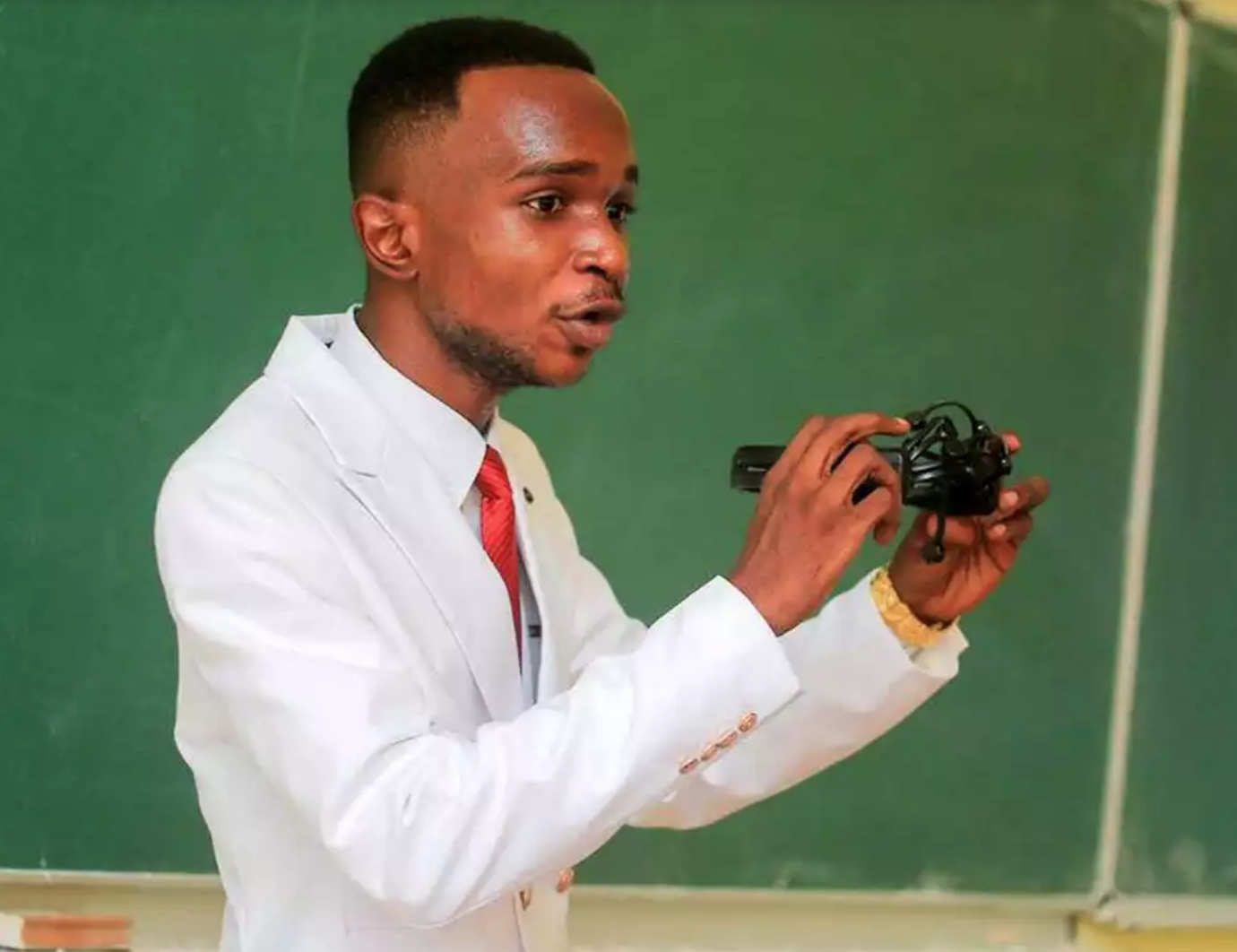
The project was inspired by an encounter near Kinshasa Central Station, where Sedi met a man using a wheelchair who was unable to move his arms or legs and depended on another person for mobility. The encounter reflected barriers faced by people with severe disabilities in Africa, including limited access to assistive technologies and care that often depends on family members, with consequences including loss of autonomy, social isolation and poverty.
How Cerebro Works
Cerebro uses a non-invasive electroencephalography headset to capture brain signals in real time. An AI model interprets the user's intended action before a control interface converts it into a command for a robotic device.

"The goal of this for us is to help people with severe motor impairments to control assistive devices using only the power of their thoughts." — Pierre Sedi, Engineer, Tosali Technologies
The system is designed to be low-cost, scalable and adapted to African realities. Sedi showed videos of participants using the interface to control a small robotic car, with experiments conducted both in a laboratory and in real-world settings.
A Journey of Persistence
Sedi, a young Congolese engineer, obtained his Master's degree in Computer Engineering at the Polytechnic Faculty of the University of Kinshasa and worked as a telecom engineer in the DRC before moving to Italy, where he is currently completing a PhD in Industrial Engineering. He set up the country's first brain-computer interface research team at the Polytechnic Faculty of the University of Kinshasa, with the aim of developing this cutting-edge technology for use in the African medical context.
The project was developed amid limited funding, frequent power outages, unstable internet access and restricted access to scientific publications. Despite these conditions, the team has conducted experiments, worked on its AI models, developed an end-to-end prototype and published research.
Award-Winning Innovation
Cerebro won the first edition of the Africa Youth in Artificial Intelligence and Robotics competition in October 2024, a continental competition created by the African Union Development Agency in partnership with ELE-VATE that evaluated more than 1,000 competitors from 55 African countries. The team was led by Sedi and included Boris Ikula, Daniel Mabanza and Samuel Matia, all from the Polytechnic Faculty of the University of Kinshasa.
Next Steps: Hospital Pilots at Kinshasa's University Clinics
The team is now seeking to conduct hospital pilots at the University Clinics of Kinshasa. The proposed work would enable bedridden patients with complete loss of motor capabilities to control a robotic bed through brain signals.
The project would combine Cerebro's brain–computer interface with a robotic bed developed by other researchers. The beds can move into a standing position, and the team intends to study whether giving patients direct control could improve comfort and rehabilitation and reduce some effects associated with prolonged bed rest.
"We want people when they hear about AI to not be scared about it, but to feel hope. We want to promote responsible use of AI. That's why our slogan is AI for people, AI for Hope." — Pierre Sedi
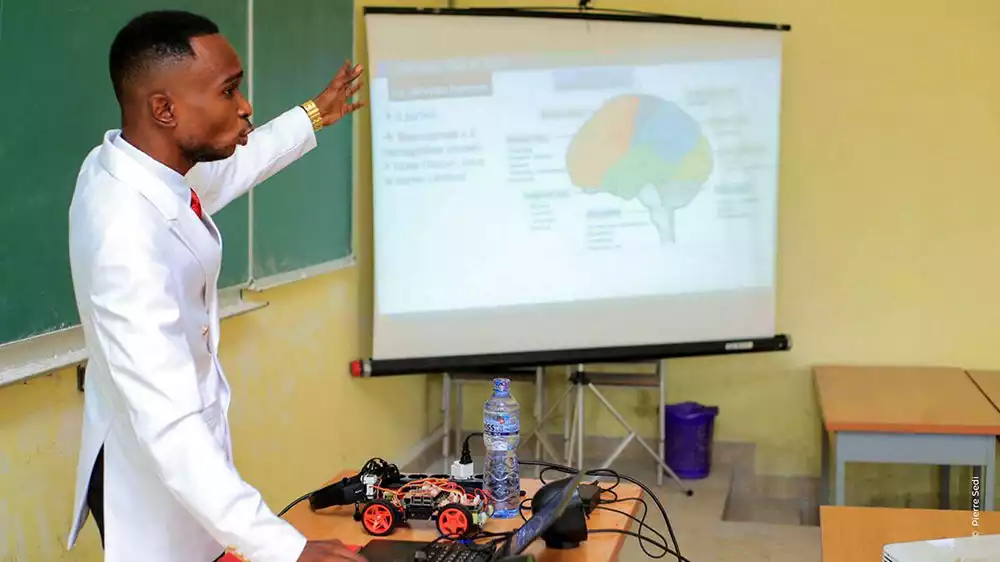
Sedi, a young Congolese engineer, obtained his Master's degree in Computer Engineering at the Polytechnic Faculty of the University of Kinshasa and worked as a telecom engineer in the DRC before moving to Italy, where he is currently completing a PhD in Industrial Engineering.
Broader Context: Brain-Computer Interface Research in Africa
Sedi's work is part of a growing body of brain-computer interface research emerging from Africa. Researchers at Nile University of Nigeria have developed a lightweight, real-time EEG-based system for imagined speech-controlled robotics, achieving high classification accuracy using XGBoost. The system is deployed on a Raspberry Pi-controlled robotic platform, enabling real-time inference.
Researchers from Morocco and other institutions have also developed EEG-based brain-computer interfaces for robotic navigation using ocular activity. These developments suggest that Africa is contributing to the global advancement of assistive robotics, with innovations designed for local contexts and constraints.
With reporting from AI for Good, the University of Kinshasa, and the African Union Development Agency.




Comments (0)
No comments yet. Be the first to share your thoughts!