



The Scale of the Opportunity
The numbers are staggering. According to the Africa Finance Corporation, the continent holds $29.5 trillion in mine site value, with $8.6 trillion still undeveloped. South Africa alone sits on an estimated R40 trillion in ore reserves. These figures are not merely abstract wealth; they represent a strategic asset that, if properly harnessed, could power factories, create jobs and build resilient regional supply chains.
The demand for critical minerals is accelerating. An electric car requires several times more mineral inputs than a conventional vehicle, and global demand for battery minerals is growing rapidly. Africa is central to this transition. South Africa and Zimbabwe together account for more than 90 percent of global platinum group metals resources. The Democratic Republic of Congo dominates global cobalt production. Guinea holds some of the world's largest bauxite reserves. Gabon is a major manganese producer.

Yet for most Africans, this mineral wealth remains an abstraction. It passes through ports, powers factories elsewhere and creates jobs on other continents. Cobalt offers a stark example: Africa accounts for the overwhelming majority of global production, yet much of the processing takes place outside the continent.
The Opportunity: Why This Moment Is Different
The global order is shifting. Goolam Ballim, chief economist at Standard Bank Group, describes the current moment not as a transition but as a rupture. The rules, institutions and assumptions that governed the post-World War II order are being replaced by power, coercion and the weaponisation of economic instruments.
That rupture is forcing governments and companies to rethink supply chains. For three decades, globalisation was organised around just-in-time delivery. Now, the world is shifting to "just in case" thinking, where reliability, continuity and commercial trust matter as much as price. Ballim points out that capital flowing from the Middle East into Africa in 2022 and 2023 was three times that from China, while Middle East-Africa trade now surpasses US-Africa trade. The continent's next growth chapter may depend less on nostalgic attachment to old Western trade routes and more on building new corridors of finance, energy, logistics and manufacturing.
Africa also has cost advantages. Building a battery precursor plant in the DRC would cost one-third as much as building a comparable plant in the US. The World Bank estimates that producing $500 million worth of copper-based products annually could generate $112 million in additional exports and create between 1,300 and 2,000 additional employment opportunities.
The Obstacles: Why Value Addition Remains Elusive
Despite decades of policy enthusiasm, Africa's manufacturing value added as a share of GDP has gone backwards. The reasons are well documented but stubbornly persistent.
Power shortages remain a binding constraint. A midstream processing plant cannot operate without reliable, affordable electricity. Yet across much of the continent, energy infrastructure is inadequate, expensive or both. Fragmented institutions and misaligned finance compound the problem. Governments announce beneficiation targets, DFIs promise capital, and lead firms demand traceability and ESG compliance. But the pieces do not line up.
Procurement practices also favour compliance-ready suppliers from outside the continent, making it difficult for local firms to participate in mineral value chains. Technology-transfer restrictions imposed by major industrial powers further constrain local beneficiation efforts. Africa also faces shortages of specialised skills in hydrometallurgy, battery chemistry and advanced materials processing.
The result is a familiar cycle: policy enthusiasm followed by stalled projects and stranded assets.
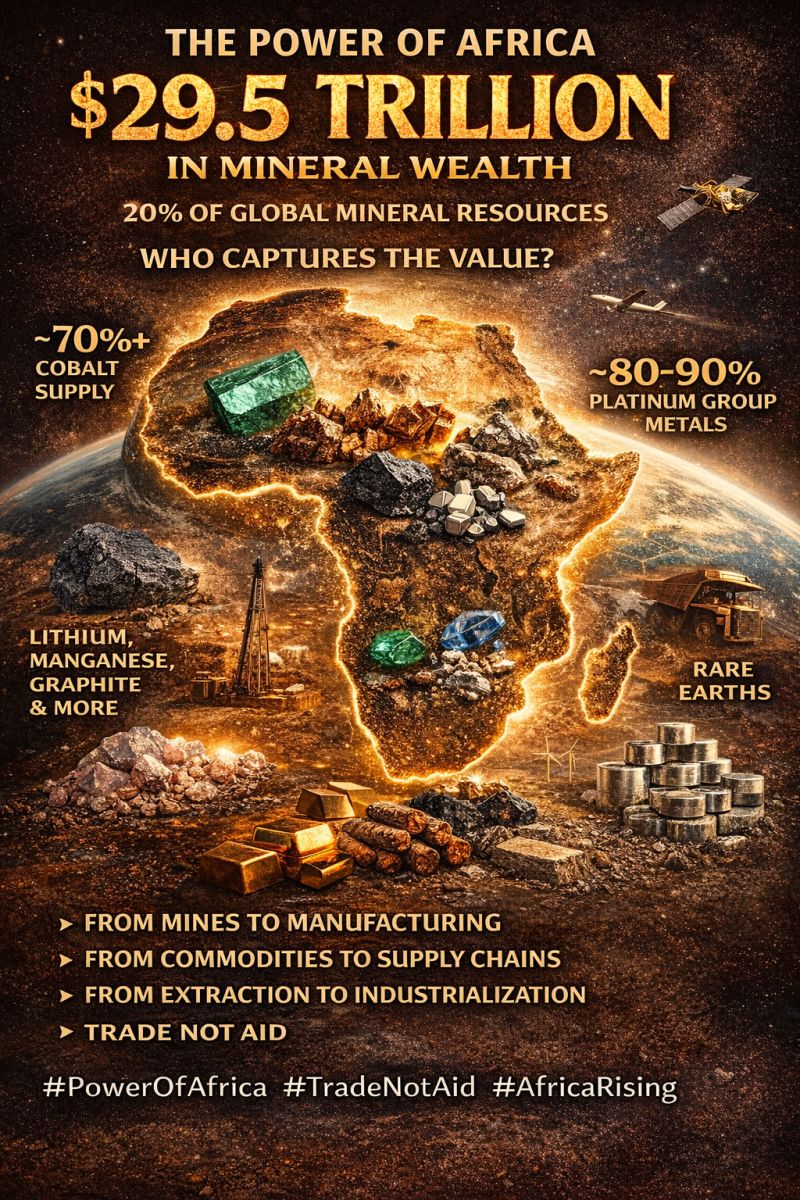
Trade! Not Aid.
The Way Forward: Practical Solutions
South African International Relations Minister Ronald Lamola has warned that mineral abundance does not automatically translate into development. "The rising demand for critical minerals can usher in a new era of shared prosperity. It can also accelerate extraction, plunder, conflict and instability," he said.
The Centre for Africa Mineral Value Chains (CAMVaC) has developed a practical framework for breaking the cycle. Its Beneficiation Linkage Matrix provides a strategic lens for identifying which investments can actually succeed, while its Beneficiation Feasibility Matrix ranks projects against three dimensions: linkage strength, institutional readiness and systemic risk. The output is not theory but a short, ranked list of priorities and a sequenced action plan that ministries, DFIs and investors can implement.
Immediate Priorities for Policymakers
First, pilot the Beneficiation Feasibility Matrix in two corridors within 12 months. One pilot should target a near-term beneficiation project that can be unlocked with targeted interventions—power allocation, concessional finance, offtake guarantees. The second should test a longer-term systemic reform package that requires institutional realignment and regional coordination. Pilots create proof points and reduce political risk for scale-up.
Second, create a small strategic intermediary to coordinate sequencing. Whether a beneficiation taskforce within an existing agency or a public-private secretariat, this body must align ministries, DFIs, state enterprises and private investors; package blended finance; and hold parties to time-bound KPIs tied to beneficiation outcomes.
Third, retool finance to reduce conversion risk. DFIs and commercial banks must move beyond single-project lending to instruments that reward local value creation: linkage finance, blended concessional tranches and performance-linked guarantees. These instruments change the calculus for lead firms and make midstream scaling commercially viable.
Industry's Role
Lead firms and original equipment manufacturers have a critical role to play. They must recognise that long-term supply chain resilience depends on building local capacity rather than simply extracting resources. The Lobito Corridor—connecting Angola, the DRC and Zambia—offers an instructive example. When port, rail and power investments are aligned with offtake and finance, corridors can anchor regional clusters and aggregate demand across borders.
The Demographic Imperative
The industrialisation question is not merely economic. It is also demographic. Africa has the world's youngest population, with a median age of about 19 years, and nearly 60 percent of its population is under 25. African economies are struggling to generate sufficient formal employment, with about three million jobs created annually compared with 10 to 12 million young people entering the labour market each year.
Lamola has argued that mining alone cannot absorb this labour force. But it can play a catalytic role in building a broader employment ecosystem if countries develop industries and services around mineral production. This includes mining equipment manufacturing, engineering services, logistics, processing, research and development, technology and downstream manufacturing.
The Role of Regional Integration
The African Continental Free Trade Area (AfCFTA) provides a key platform for integration, while the African Union's African Green Minerals Strategy, adopted in 2025, identifies the AfCFTA as a mechanism to support regional and continental value chain development and increase value addition. Greater coordination would allow the continent to develop regional mineral value chains rather than competing individually for investment.
This requires improved movement of goods, services, capital, skills and technology across borders, supported by stronger cooperation on infrastructure, energy, transport and financial systems.
A Strategic Asset Waiting to Be Converted
Africa's mineral endowment is no longer a speculative talking point. It is a strategic asset waiting to be converted into factories, jobs and resilient regional supply chains. The question is no longer whether the resources exist. It is why, after decades of talk, the conversion to industrial capacity remains so elusive.
The window of opportunity is open but not guaranteed. As the world shifts to "just in case" thinking, Africa has a chance to position itself as a reliable partner in critical mineral value chains. But that requires more than rhetoric. It requires disciplined, sequenced interventions that actually build midstream and downstream capacity.
The Lobito Corridor, the AfCFTA and growing demand for critical minerals all point in the same direction: Africa's mineral wealth can be a foundation for industrialisation rather than a source of dependency. The challenge is to ensure that the continent's resources benefit its own people, rather than primarily enriching foreign governments, multinational corporations or political elites.
Africa has grown before, but it has not transformed. The next decade will determine whether that changes.
With reporting from the Africa Finance Corporation, Standard Bank Group, the Centre for Africa Mineral Value Chains, the Mail & Guardian, the Daily Maverick, Mining Review Africa, the University of Oxford's School of Global and Area Studies and Sabinet African Journals.












Comments (0)
No comments yet. Be the first to share your thoughts!